National Security 101
A Researcher’s Guide to National Security Research
This guide covers the landscape, the programs, the process, and the rules, written for UW–Madison researchers who are new to the space. You do not need a national security background to do national security research, and there is a good chance you already have something to offer. WINS is here to help any researcher interested in this work.
The Funding Landscape
The Defense Science Enterprise
The Department of Defense is one of the largest funders of university research in the country. Its basic-science arms — the Office of Naval Research, the Air Force Office of Scientific Research, and the Army Research Office — fund investigator-driven work much like NSF does, alongside the service laboratories and Defense Advanced Research Projects Agency, which pursues high-risk, high-payoff programs.
Beyond the Pentagon
National security funding is much bigger than DoD: the Department of Energy and NNSA (nuclear security, energy, and the national laboratories), the Intelligence Community and Intelligence Advanced Research Projects Agency, the Defense Threat Reduction Agency, the Department of Homeland Security, and more. If your work touches energy, computing, biology, sensing, materials science, or people — someone in the national security landscape funds it.
How DoD Thinks About Research
DoD budgets research through numbered categories called budget activities — 6.1 basic research through 6.8 software programs — and knowing where your work sits on that spectrum tells you which programs, sponsors, and expectations fit. Most university research lives at the front of it. The full breakdown appears later in this guide.
Programs Every Researcher Should Know
Wisconsin is an eligible state for the Defense Established Program to Stimulate Competitive Research (DEPSCoR) — a program run by the Office of the Under Secretary of Defense for Research and Engineering specifically to grow DoD-relevant research capacity in states like ours. Its Research Collaboration track is designed for tenured and tenure-track faculty who are new to DoD funding, and annual announcements appear on grants.gov.
MURI funds university teams attacking hard basic-research problems that cross disciplines — typically five years of substantial support built around a topic the services announce each year. MURIs are among the most prestigious awards in defense science, and their topic lists are a window into what the department believes matters next.
ONR, the Army Research Office, and AFOSR each run Young Investigator Programs, and DARPA runs the Director’s Fellowship and Young Faculty Award — early-career awards analogous to the NSF CAREER, designed to bring new researchers into the defense science community. If you are early-career and your work maps to a service’s interests, these programs are built for you.
The Defense University Research Instrumentation Program funds the equipment behind the research — instruments and infrastructure that university budgets rarely cover. DURIP proposals are short, the awards are equipment-only, and they pair naturally with an existing or planned research program.
If your research is heading toward a company, the Small Business Innovation Research and Small Business Technology Transfer programs are the defense world’s front door for small firms — and STTR specifically requires a university research partner. Wisconsin’s spinout tradition, from fusion to quantum, has traveled this road. Existing small businesses — in Wisconsin, or anywhere in the country — may also want to team with you.
Much DoD science funding flows through standing Broad Agency Announcements (BAAs) — open, rolling calls where you propose your idea rather than answer a prescribed topic. The usual path: a short white paper first, feedback from the program officer, then a full proposal by invitation. Small “seedling” awards often start a relationship before larger programs follow.
How the Process Works
The single biggest cultural difference from NSF and NIH: in the DoD world, you are expected to talk to the program officer before you propose. Program officers describe scientific matchmaking as part of their job — they want to hear bold new ideas, steer you toward the right program, and share your idea with colleagues if theirs is not the fit. A short email with a one-page concept is a normal, welcome first move.
Grant-style opportunities post on grants.gov; contract solicitations post on SAM.gov; each agency also maintains standing BAAs on its own site. The DoD Critical Technology Areas and each service’s science and technology strategy tell you what sponsors care about before any solicitation appears.
DoD funds universities through grants and cooperative agreements (familiar territory), contracts (deliverables and milestones — read the terms), Other Transaction agreements (flexible vehicles increasingly used for prototypes and consortia), and CRADAs (collaboration frameworks with government laboratories, usually without funds changing hands). The mechanism shapes your obligations — UW–Madison’s research administration offices and WINS can help you read what you are signing up for.
Sponsors describe maturity in Technology Readiness Levels, from TRL 1 (basic principles) to TRL 9 (proven in operation). University research usually lives at TRL 1–4 — and that is what basic-research sponsors want. Expect white-paper-to-award timelines of months, annual reporting, and program officers who stay engaged with your work. Many researchers find DoD sponsorship among the most collegial funding relationships they hold.
6.1 / 6.2 / 6.3 — DoD RDT&E budget activities for basic research, applied research, and advanced technology development; the categories where most university work lives (6.4 through 6.8 fund prototyping, systems development, and operational systems).
AAL — Army Applications Laboratory, which connects Army problems with commercial and academic solutions.
AFC — Army Futures Command, which oversees Army modernization priorities and major research and development.
AFOSR — Air Force Office of Scientific Research, the basic-science funding office of AFRL.
AFRL — Air Force Research Laboratory.
AFWERX — The Air Force’s innovation arm, connecting commercial and academic innovators with Air Force and Space Force needs.
AI2C — Army Artificial Intelligence Integration Center.
ARL — DEVCOM Army Research Laboratory, the Army’s corporate research laboratory.
ARLIS — Applied Research Laboratory for Intelligence and Security at the University of Maryland, the Intelligence Community’s university-affiliated research center.
ARO — Army Research Office, ARL’s basic-research funding arm.
ARPA-E — Advanced Research Projects Agency–Energy, the Department of Energy’s high-risk, high-reward energy research agency.
BAA — Broad Agency Announcement, a standing open call for proposals in areas an agency describes broadly rather than as a specific task.
BARDA — Biomedical Advanced Research and Development Authority, the Department of Health and Human Services office that funds medical countermeasures.
CAE-R — National Center of Academic Excellence in Cyber Research, a designation from the National Security Agency.
CDMRP — Congressionally Directed Medical Research Programs, the DoD’s congressionally funded medical research portfolio.
CISA — Cybersecurity and Infrastructure Security Agency, part of the Department of Homeland Security.
CMMC — Cybersecurity Maturity Model Certification, the DoD cybersecurity standard required of contractors and institutions that handle controlled information.
CRADA — Cooperative Research and Development Agreement, a collaboration agreement with a federal laboratory.
CTA — Critical Technology Area, one of the technology priorities defined by the Office of the Under Secretary of Defense for Research and Engineering.
CUI — Controlled Unclassified Information, unclassified information that federal rules require to be protected with specific data-handling practices.
DARPA — Defense Advanced Research Projects Agency.
DEFENSEWERX — A network of innovation hubs serving DoD mission commands; ForwardWERX is the Wisconsin National Guard’s hub.
DEPSCoR — Defense Established Program to Stimulate Competitive Research, a DoD program supporting researchers in eligible states, including Wisconsin.
DEVCOM — U.S. Army Combat Capabilities Development Command, the parent command of ARL and the Army’s research centers.
DHS — Department of Homeland Security.
DIU — Defense Innovation Unit, which accelerates commercial technology into the military.
DNN — NNSA’s Office of Defense Nuclear Nonproliferation.
DoD — Department of Defense.
DOE — Department of Energy.
DPAA — Defense POW/MIA Accounting Agency, responsible for accounting for missing service members from past conflicts.
DSIP — DoD SBIR/STTR Innovation Portal, the front door for small-business research funding.
DTRA — Defense Threat Reduction Agency, the DoD’s combat support agency for countering weapons of mass destruction.
DURIP — Defense University Research Instrumentation Program, which funds research equipment at universities.
ERDC — U.S. Army Engineer Research and Development Center, the research arm of the Army Corps of Engineers.
ERIS — Expedited Research Implementation Series, DARPA’s standing open marketplace for new technology proposals.
FBI — Federal Bureau of Investigation.
FFRDC — Federally Funded Research and Development Center, a government-sponsored research organization operated by a university, nonprofit, or company.
IARPA — Intelligence Advanced Research Projects Activity, the Intelligence Community’s counterpart to DARPA.
IC — The Intelligence Community, the federal agencies that conduct intelligence activities.
INSURE — Intelligence and Security University Research Enterprise, the academic consortium of ARLIS.
ITAR / EAR — International Traffic in Arms Regulations and Export Administration Regulations, the export control regimes governing defense and dual-use technology.
LDRD — Laboratory Directed Research and Development, the discretionary research programs of the national laboratories.
LRBAA — Long-Range Broad Agency Announcement, DHS Science and Technology’s standing open call.
MOU — Memorandum of Understanding.
MTEC — Medical Technology Enterprise Consortium, a biomedical consortium that works with DoD and other agencies under Other Transaction Authority.
MURI — Multidisciplinary University Research Initiative, the DoD’s flagship university basic-research program.
NASA — National Aeronautics and Space Administration.
NBAF — National Bio and Agro-Defense Facility, the USDA’s laboratory for animal disease defense.
NIH — National Institutes of Health.
NIST — National Institute of Standards and Technology.
NNSA — National Nuclear Security Administration, the Department of Energy agency responsible for nuclear security and nonproliferation.
NRO — National Reconnaissance Office.
NSA — National Security Agency.
NSF — National Science Foundation.
NSSC — Nuclear Science and Security Consortium, an NNSA-funded university consortium.
ONR — Office of Naval Research.
OTA — Other Transaction Authority, a flexible federal agreement type outside traditional contracts and grants, often used through consortia.
OUSD(R&E) — Office of the Under Secretary of Defense for Research and Engineering, the DoD’s chief technology office.
PO / PM — Program officer or program manager, your scientific counterpart at the funding agency.
Q-BID — Quantum & Battlefield Information Dominance, one of the DoD Critical Technology Areas.
QED-C — Quantum Economic Development Consortium, the NIST-supported industry consortium for the U.S. quantum economy.
RDT&E — Research, Development, Test, and Evaluation, the DoD budget title that funds research.
RISC — Research for Intelligence and Security Challenges, ARLIS’s internship program placing students with DoD and IC mentors.
SAM.gov — System for Award Management, the federal registration and contract opportunities system.
SBIR / STTR — Small Business Innovation Research and Small Business Technology Transfer, federal small-business research programs; STTR requires a university partner.
SMART — Science, Mathematics, and Research for Transformation, the DoD scholarship-for-service program.
TRL — Technology Readiness Level, the 1-to-9 scale describing how mature a technology is.
UARC — University Affiliated Research Center, a university-based research organization with a long-term strategic relationship to a DoD or IC sponsor.
USCYBERCOM — U.S. Cyber Command.
USDA — U.S. Department of Agriculture.
Research Security & Compliance
The great majority of national security research at universities is fundamental research: openly published, openly discussed, and performed by students and faculty like any other scholarship. Longstanding federal policy holds that fundamental research should remain unrestricted to the maximum extent possible, and UW–Madison’s engagement is built on that principle. If a specific project carries publication or participation constraints, those constraints are disclosed up front — and participation is always your choice.
Export control law governs sharing certain technologies and technical data with foreign nationals — including, in some cases, inside your own lab. Most fundamental research is not export controlled, but equipment, software, and some sponsored projects can be. The rule of thumb: if a sponsor mentions export control or foreign-national restrictions, contact the university’s export control staff before you sign anything — they exist to find the path, not to block it.
Federal sponsors now require complete disclosure of your current and pending support, appointments, and collaborations — and the consequences of incomplete disclosure are serious. The rule is simple: disclose everything, everywhere, every time, and when in doubt, ask. UW–Madison’s Research Security Program exists to help you get this right.
Most university national security research is not controlled or classified. Some projects handle Controlled Unclassified Information (CUI), which requires specific data-handling practices. UW–Madison is building a dedicated CUI research enclave designed for Cybersecurity Maturity Model Certification (CMMC) Level 2 compliance, expected to be ready by mid 2027, so campus researchers can take on CUI-bearing projects without constructing their own secure environments.
Work requiring clearances or classified environments happens through dedicated pathways and partnerships governed by university policy and state law. If your work is heading that direction, start the conversation early.
From 6.1 to 6.8: Where University Research Lives
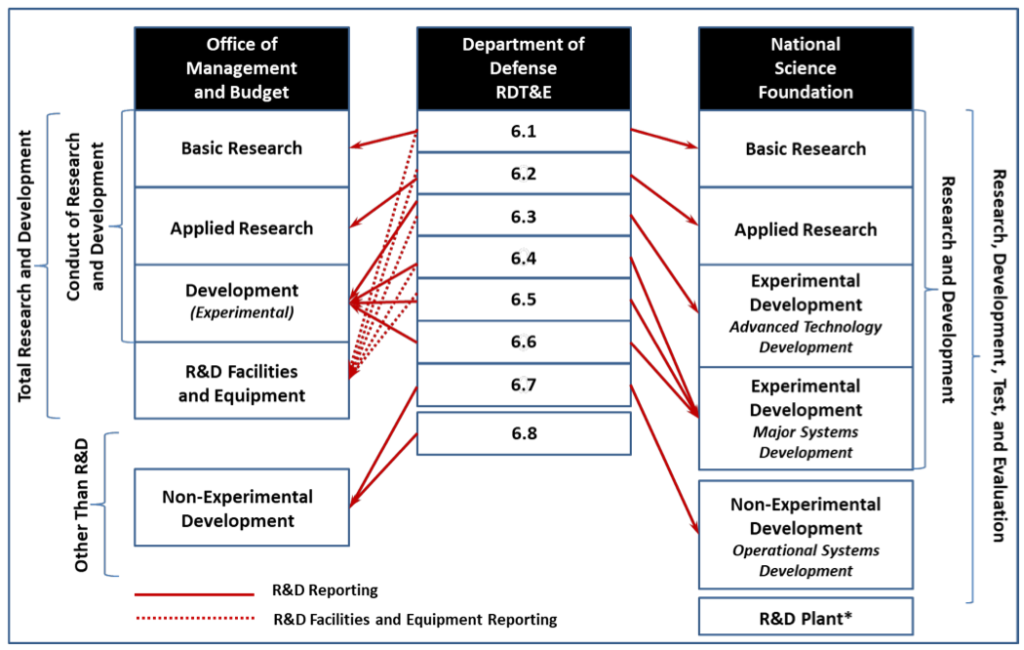
DoD organizes its research, development, test, and evaluation (RDT&E) budget into eight budget activities, universally known by their numbers. The number on the money shapes everything: what the sponsor expects, whether the work is openly publishable, and who typically performs it.
Scale matters. Of DoD’s roughly $180 billion (FY26) annual RDT&E budget, about 11 percent — some $20 billion — is science and technology funding (6.1–6.3), and that is the part built for universities. It is a small share of the department’s budget — and still more than twice the size of NSF. Within it, basic research (6.1) runs about $2.3 billion a year and applied research (6.2) about $6 billion.
The Practical Takeaway
University research lives overwhelmingly in 6.1 and 6.2, reaches into 6.3 through centers and partnerships, and often hands off to industry — including university startups — beyond that. If your funding is 6.1 or 6.2, expect research norms — publications, students, conferences. What DoD considers “fundamental research” exists across both 6.1 and 6.2. WINS or your research administrator can help you understand what you are signing up for.
Your First Three Steps
1. Map your research to the mission
Read the DoD Critical Technology Areas and skim a relevant agency’s research interests. Ask not “is my work defense research?” but “what mission problem does my work touch?” The answer is usually closer than you think.
2. Join the community
Join the campus National Security Google Group for opportunities and news and browse the WINS Resources directory of agencies, programs, and opportunities. The community is diverse, welcoming, and glad to compare notes.
3. Talk to WINS
Tell us what you work on — that is all it takes to start. WINS helps researchers find the sponsors whose missions need their science, navigate the mechanics, and make the connections. Email nationalsecurity@wisc.edu.