Spectrum
Electromagnetic Spectrum & Microelectronics at Wisconsin
Supports: Quantum & Battlefield Information Dominance · Scaled Directed Energy
UW–Madison’s applied electromagnetics community is internationally recognized for research spanning antennas and phased arrays, high-power microwave sources, vacuum electronics, and millimeter-wave and terahertz systems. UW–Madison builds the microelectronics that turn electromagnetic spectrum research into capabilities. The electromagnetic spectrum is a contested domain — every mission senses through it, connects through it, and must protect it.
Research Strengths
radar & remote sensing · antennas & phased-array systems · electrically small antennas · metamaterials · RF & millimeter-wave systems · terahertz science & sensing · computational electromagnetics · wave propagation · high-power microwaves & vacuum electronics · directed energy · counter-uncrewed aircraft systems · electronic warfare & spectrum operations · secure & resilient communications · wireless power transfer · standoff chemical detection · acoustic & ultrasonic sensing · nondestructive evaluation · bioelectromagnetics · microelectronics & semiconductor devices · wide-bandgap semiconductors · heterogeneous integration & chiplets · integrated photonics
Sense · Connect · Discover · Build
Sense
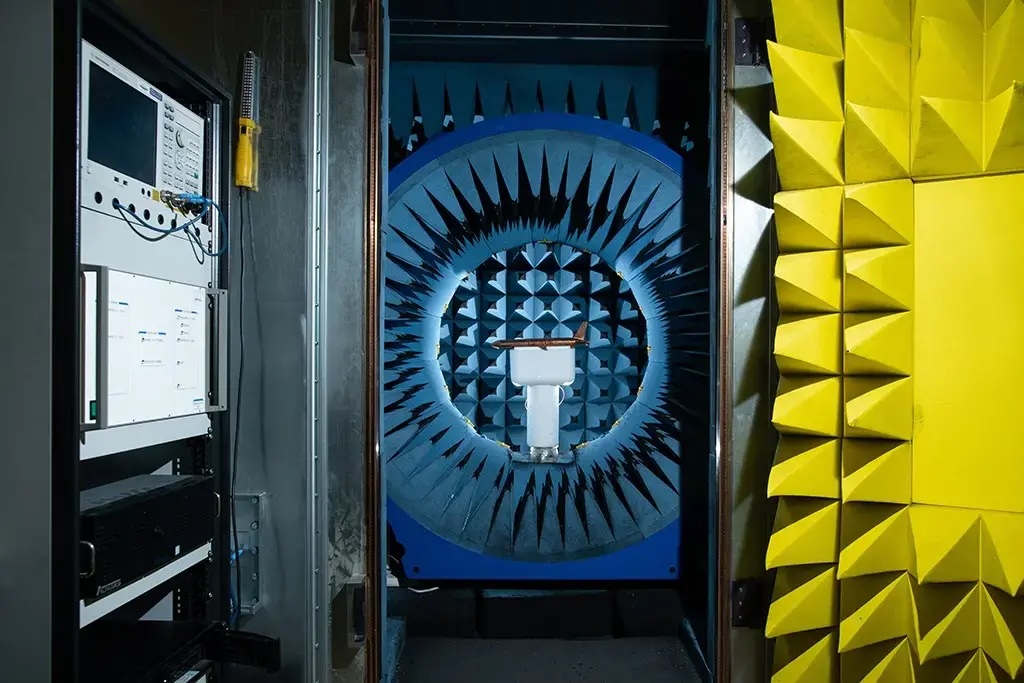
Wisconsin electromagnetics researchers develop the apertures the mission sees through: phased-array antennas from low-cost to extremely high-power, compact wideband HF systems and small-aperture direction finding, and electrically small antennas — developed with IARPA support — that break the fundamental bandwidth-efficiency limits constraining tactical radios. A near-field anechoic measurement facility characterizes antennas from 600 MHz to 18 GHz — including on scaled models of aircraft and ships.
Connect
Assured communication in contested environments — adaptive beam-pointing for troposcatter links, interference suppression for co-sited antennas, X-ray communications for space, and research spanning 100 MHz to a terahertz and beyond — keeps the force connected when the spectrum is denied, degraded, or under attack.
Discover
High-power microwave sources and amplifiers, vacuum electronics and advanced cathodes, and high-power-capable phased arrays serve the demands of radar, electronic warfare, directed energy, and counter-uncrewed systems — while research on how pulsed microwaves affect the brain builds the bioeffects science responsible spectrum operations require.
Build
Wisconsin CHIPS — the statewide hub for semiconductor research and workforce development, and a member of the DoD Microelectronics Commons through the Southwest Advanced Prototyping Hub — spans wide-bandgap semiconductors, heterogeneous chiplet systems, integrated photonics, quantum information science, and AI-aided manufacturing, with end-to-end facilities from epitaxial growth to microfabrication to high-resolution microscopy alongside the Wisconsin Centers for Nanoscale Technology cleanroom — and statewide workforce partnerships preparing the talent domestic fabrication requires.
The Dual-Use Imperative
Spectrum research may be Wisconsin’s best-proven dual-use story. The same microwave engineering behind defense systems produced minimally invasive cancer-ablation technology that became NeuWave Medical — acquired by Johnson & Johnson. Antenna science powers 5G, satellite internet, and precision agriculture. Radar drives the weather forecast and automotive safety. Terahertz sensing screens for threats and images tissue. And the microelectronics base built for the mission is the same one inside every device in American life.
Why It Matters
Every domain of modern conflict runs through the electromagnetic spectrum — sensing, targeting, communicating, jamming, and defending against the drone-saturated environments. UW–Madison research spans the full spectrum: the apertures that sense, the links that connect, the high-power sources that contest, and domestic microelectronics these systems require.
WINS connects mission partners to Wisconsin’s spectrum and microelectronics researchers, laboratories, and fabrication infrastructure.