Fusion
Fusion Science at Wisconsin
Signature Strength · Supports: Strategic Energy · Scaled Directed Energy
Few institutions have contributed more to fusion science than UW–Madison. Across decades of sustained research in plasma physics and fusion engineering, the university has trained hundreds of Ph.D. plasma physicists, operates multiple experimental fusion devices, and seeded a cluster of fusion companies that has made Wisconsin a national center of the emerging fusion industry.
Limitless distributed power — fusion-driven energy with transport at terawatt scale — is one of the College of Engineering’s six Engineering Moonshots, and sustainable energy systems are a central theme of the campuswide RISE-EARTH initiative.
Research Strengths
magnetic mirror confinement · high-field HTS magnets · stellarator optimization · spherical tokamaks · plasma physics & diagnostics · fusion neutronics & materials · fusion engineering & systems · medical isotope production
Related: Research Domain
The rest of the energy enterprise
Advanced fission, nonproliferation and safeguards, grid resilience, and engines and propulsion: the Nuclear & Energy Systems page. Explore Nuclear & Energy →
Experimental Facilities
WHAM
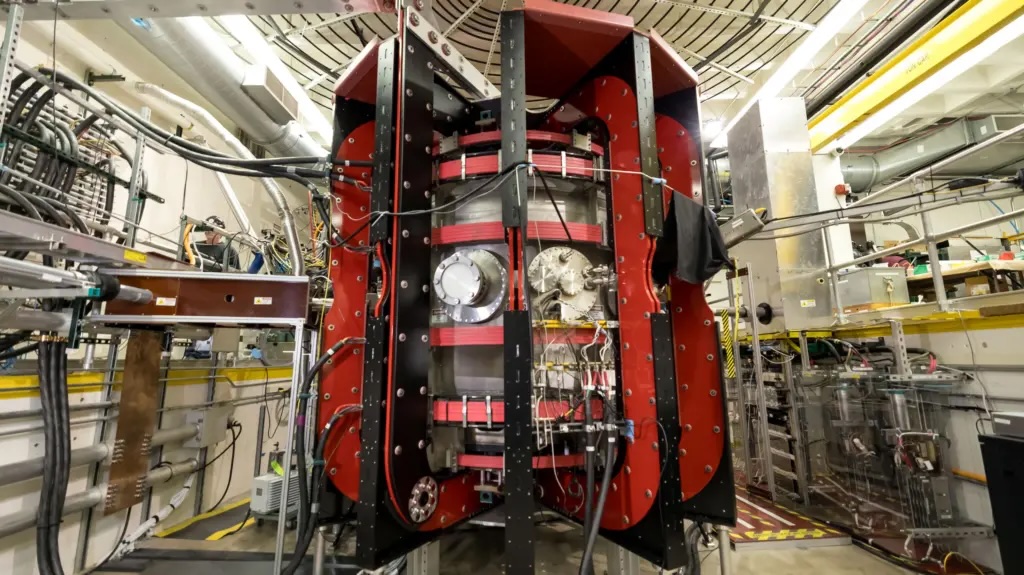
The Wisconsin HTS Axisymmetric Mirror, built in partnership with MIT and Commonwealth Fusion Systems, uses high-temperature superconducting magnets to revive and modernize the magnetic mirror concept — achieving in 2024 the highest magnetic field ever applied to confine a plasma.
Pegasus-III
A spherical tokamak experiment in the Department of Engineering Physics advancing the understanding of magnetically confined high-temperature plasmas, with the goal of lowering the cost of future fusion energy production.
HSX & WiPPL
The Helically Symmetric eXperiment — a one-of-a-kind optimized stellarator — and the Wisconsin Plasma Physics Laboratory, home of the Madison Symmetric Torus, round out one of the most diverse university fusion research portfolios in the world.
From Lab to Industry
Wisconsin’s fusion research has launched a wave of companies commercializing technologies pioneered on campus — including Realta Fusion, advancing compact magnetic mirror fusion systems born from the WHAM program; SHINE Technologies, applying fusion processes to medical isotope production and inspection; and Type One Energy, pursuing stellarator fusion power built on lessons from HSX. Together they have made the Madison region one of the nation’s most active fusion industry clusters.
The Dual-Use Imperative
Fusion’s civilian promise is the biggest energy prize there is: clean, abundant power for everyone. But the dividends are already arriving; for example, fusion processes produce the medical isotopes used in cancer diagnosis and treatment, plasma science underpins the semiconductor manufacturing behind every modern device, and high-field magnet technology advances medical imaging and scientific instruments worldwide.
Why It Matters
For national security, fusion represents more than future energy: it is strategic energy resilience, industrial base strength, and leadership in a technology race the United States cannot afford to lose. And the plasma science underneath it — confinement, high-field magnets, plasma-materials interaction — is the same expertise that underpins next-generation defense technologies, including directed energy.
WINS connects mission partners to Wisconsin’s fusion and plasma researchers, facilities, and industry cluster.