
Cyber
Cybersecurity and Cyber Operations at Wisconsin
Supports: Quantum & Battlefield Information Dominance · NSA CAE-R
Cyberspace is contested terrain, and the nation’s ability to defend it starts with research and the people who do it. UW–Madison is designated by the National Security Agency as a National Center of Academic Excellence in Cyber Research, is a founding member of U.S. Cyber Command’s Academic Engagement Network, and works side by side with the federal, state, and industry partners who defend the nation’s networks every day.
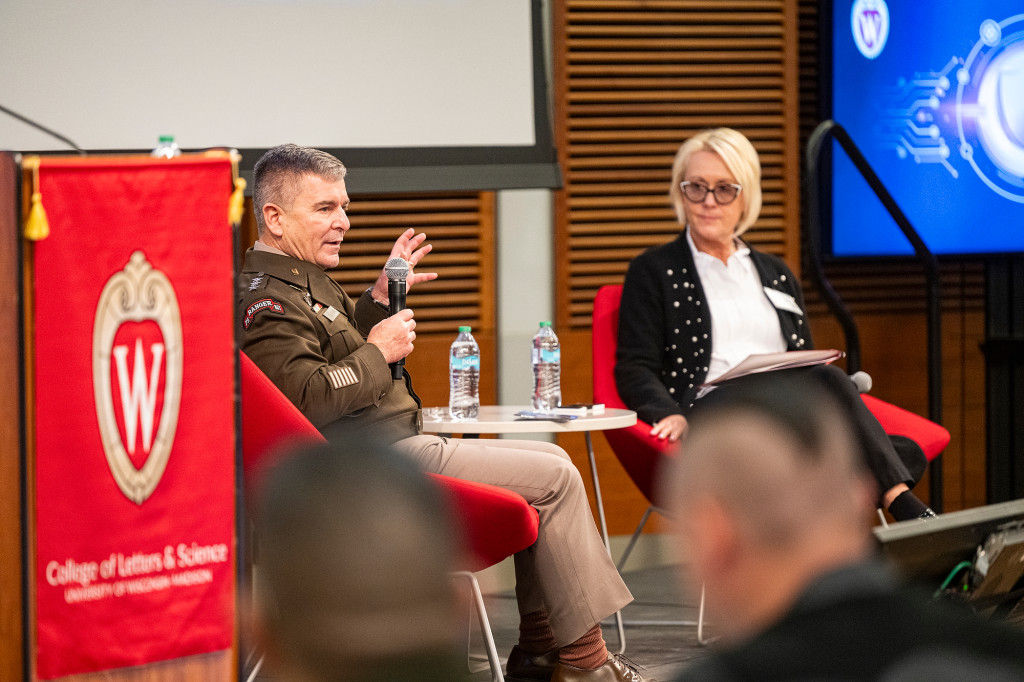
Lt. Gen. (ret) Joe Hartman, previously acting head of U.S. Cyber Command and the National Security Agency (NSA), and Dorota Brzezińska, UW–Madison Vice Chancellor for Research, discuss advancing cyber capabilities, developing new technologies and preparing a capable workforce at the UW–Madison Cyber Research Forum. Hartman is a UW–Madison National Security Fellow.
Research Strengths
systems & software security · network security · cryptography · post-quantum cryptography · privacy-enhancing technologies · AI & machine learning security · critical infrastructure defense · cyber operations & exercises · cyber workforce development
Designations & National Partnerships
NSA Center of Academic Excellence
The CAE in Cyber Research designation recognizes the quality and impact of UW–Madison’s cybersecurity research and opens doors across the national security community, including DoD Cyber Service Academy scholarships that pay students’ tuition in exchange for federal cyber service.
U.S. Cyber Command Engagement
A founding member of USCYBERCOM’s Academic Engagement Network, UW–Madison has hosted senior Cyber Command, Cyber National Mission Force, and National Security Agency leaders on campus and fields student teams in the command’s Cyber RECon research and education challenge.
Defense Intelligence Enterprise
UW–Madison is a founding member of INSURE, the Intelligence and Security University Research Enterprise serving the Defense Intelligence and Security Enterprise in AI, autonomy, and advanced computing, with paid RISC internships that place students with Department of Defense and Intelligence Community mentors.
Research Community
MADS&P
The UW–Madison Security and Privacy Research Group is the university’s home for computer security and privacy research, including systems security, software security, cryptography, and privacy-enhancing technologies.
College of Computing & Artificial Intelligence
Security research across the college spans computer sciences, statistics, and information science, from secure systems and software analysis to quantum-era cryptography.
Data Science Institute
A campus hub for data science research and partnership, connecting the methods, infrastructure, and people behind data-driven security, from analytics and detection to trustworthy systems.
Exercises & Workforce
Cyber Badger
An annual student exercise built around real-world cyber scenarios, developed and executed with Cybersecurity and Infrastructure Security Agency, the FBI, the Department of Energy, the Wisconsin National Guard, national laboratories, utilities, and other federal, state, and industry partners.
Wisconsin National Guard
UW–Madison partners via an MOU with the Wisconsin National Guard 176th Cyber Protection Team, Defensive Cyberspace Operations Element, and the state’s Cyber Response Team for exercises, expertise, and reciprocal facility access.
Pipeline to Service
From student cybersecurity organizations to federal scholarship-for-service programs and internships across the defense and intelligence communities, Wisconsin builds the workforce the nation’s cyber mission depends on.
The Dual-Use Imperative
Cyber defense is everyone’s defense. The research that secures military networks is the same research that protects hospitals, banks, water utilities, and school districts. Post-quantum cryptography, the technology that protects information from new attacks enabled by quantum computers, will guard every citizen’s data. And the cyber workforce Wisconsin trains defends companies and communities across the economy — the vast majority of cyber careers are civilian.
Why It Matters
Post-quantum cryptography, resilient critical infrastructure, secure software supply chains, and battlefield information dominance are built on the kind of foundational security research universities do best. Wisconsin pairs that research with national designations, founding roles in the defense cyber and intelligence enterprises, and exercises that put students shoulder to shoulder with the agencies they may one day join.
WINS connects mission partners to Wisconsin’s cybersecurity researchers, programs, and partnerships.