Space
Space & Earth Sensing at Wisconsin
Supports: Quantum & Battlefield Information Dominance · Space Domain Awareness
Understanding the operating environment — from orbit to atmosphere to surface — is a foundation of every mission. For decades, UW–Madison’s Space Science and Engineering Center has built the instruments and algorithms that turn observations from space into knowledge, making Wisconsin one of the world’s leading centers of environmental intelligence. That reach extends to the South Pole, where the IceCube Neutrino Observatory, built and operated by UW–Madison, was recognized with the 2026 Nobel Prize in Physics.
Research Strengths
satellite meteorology · hyperspectral infrared sounding · sensor & instrument development · instrument calibration & validation · atmospheric characterization · severe weather detection & nowcasting · environmental intelligence · smallsat & CubeSat missions · real-time data processing & visualization · distributed sensor networks · extreme-environment instrumentation · freshwater & Great Lakes observation
Anchors & Assets
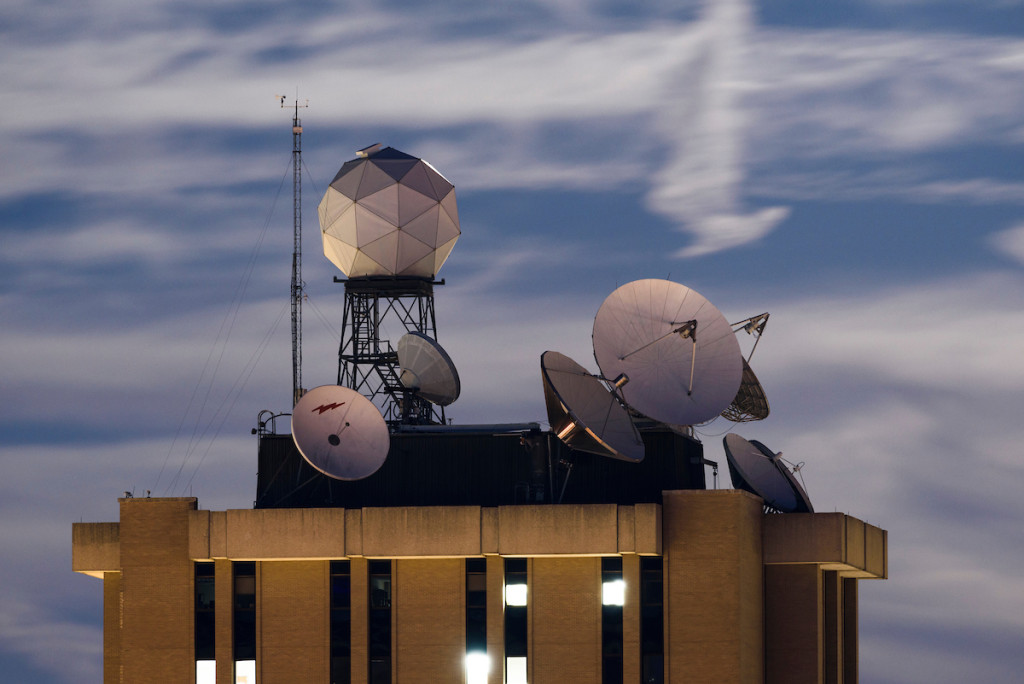
Space Science and Engineering Center
An internationally renowned research center in the Office of the Vice Chancellor for Research, developing satellite-, aircraft-, and ground-based instrumentation and the systems that collect, process, and distribute their data.
Cooperative Institute for Meteorological Satellite Studies
The Cooperative Institute for Meteorological Satellite Studies is a world-renowned satellite meteorology research center housed within SSEC, representing long partnership with National Oceanic and Atmospheric Administration and other federal agencies.
From Instruments to Insight
High-performance data ingest, processing, and visualization systems — the software and ground infrastructure that make space-based sensing usable in real time.
IceCube & Extreme-Environment Sensing
The Wisconsin IceCube Particle Astrophysics Center operates the IceCube Neutrino Observatory: 5,160 optical sensors frozen into a cubic kilometer of ice beneath the South Pole, fielded and sustained for 15 years by a collaboration of some 450 scientists from 58 institutions in 14 countries. The discovery of high-energy astrophysical neutrinos it made possible earned the 2026 Nobel Prize in Physics. For mission partners, it is proof that Wisconsin can design, deploy, network, and operate large distributed sensor arrays where little else survives.
Physical Sciences Laboratory
UW–Madison’s own design and fabrication house in Stoughton, a center of the Office of the Vice Chancellor for Research with more than 6,000 projects completed since 1967: the hot-water drill that placed IceCube’s sensor strings, detector prototypes for CERN and the Deep Underground Neutrino Experiment, instrumentation for lake and field science, and the site where the WHAM fusion experiment was built and tested. When a mission needs hardware that does not exist yet, PSL builds it.
Freshwater & Great Lakes Observation
The Center for Limnology leads the NSF North Temperate Lakes Long-Term Ecological Research program, with instrumented buoy networks, high-frequency lake sensor data, research vessels, and field stations, while Wisconsin Sea Grant brings Great Lakes field operations and coastal science. Together they are the observing base for the maritime environment at Wisconsin’s doorstep.
The Dual-Use Imperative
Space-based sensing may be the original dual-use success story — and Wisconsin wrote its first chapter. The satellite meteorology pioneered here powers the weather forecast every person checks each morning, the warnings that precede hurricanes and tornadoes, the climate record, aviation safety, and precision agriculture. The same instruments that inform military operations protect civilian lives every day.
Why It Matters
Weather shapes operations; the space domain shapes everything. Environmental intelligence, atmospheric characterization, the sensing technologies that see through contested and denied environments, and sensor networks that keep working in the harshest places on Earth are enduring mission needs — and enduring Wisconsin strengths.
WINS connects mission partners to Wisconsin’s sensing instruments, data systems, and scientists.